Energy Efficiency, Condensation Prevention, and System Protection
Thermal Insulation in Elastomeric Foam: Energy Efficiency, Condensation Prevention, and System Protection
Today, discussing thermal insulation means addressing fundamental topics such as energy efficiency, sustainability, and long-term system reliability.
In the HVAC and industrial sectors, insulation is no longer considered a simple auxiliary technical component, but rather a strategic element capable of directly influencing:
• energy consumption
• system performance
• installation durability
• operating and maintenance costs
• compliance with European regulations
Recent European directives, such as the EPBD (Energy Performance of Buildings Directive) and the EED (Energy Efficiency Directive), are accelerating the transformation of the building and plant engineering sectors by introducing increasingly stringent targets for reducing energy consumption and CO₂ emissions.
In this context, choosing a suitable thermal insulation system plays a central role in the design of efficient, safe, and sustainable systems.
Among the most high-performing and versatile solutions available today, closed-cell elastomeric foam (FEF) represents one of the leading technologies for the insulation of civil and industrial systems.
Why Thermal Insulation is Essential in HVAC and Industrial Systems
Every heating or refrigeration system inevitably generates energy losses. Pipes, ducts, and components that are not properly insulated can compromise the overall efficiency of the system, causing:
• energy loss
• increased energy consumption
• reduced system performance
• condensation formation
• corrosion of metal surfaces
• increased maintenance costs
In many cases, thermal losses represent one of the main causes of energy inefficiency in buildings and industrial plants.
Proper insulation, on the other hand, makes it possible to:
✔ maintain stable fluid temperature
✔ reduce the system’s energy load
✔ improve operational performance
✔ extend the lifespan of the system
These advantages are fundamental in applications such as:
• air conditioning
• refrigeration
• heating
• air handling systems
• industrial plants
Condensation: The Invisible Problem That Can Compromise a System
One of the most critical aspects in HVAC systems is condensation formation. When the surface temperature of a pipe drops below the dew point of the surrounding environment, moisture forms on the external surface of the system.
This phenomenon can cause:
• corrosion of pipes if condensation reaches the metal surface
• dripping in passage areas, with potential safety implications
• deterioration of the insulation material and consequent loss of thermal performance
• formation of mold and humidity in the areas crossed by the systems
• damage to technical systems
• loss of energy efficiency
For this reason, when selecting an insulation material, it is essential to evaluate not only the anti-condensation thickness, but also the material’s ability to resist water vapor diffusion. A key parameter is the μ (MU) value, which measures resistance to vapor diffusion.
Closed-cell elastomeric foam stands out precisely because of:
✔ high resistance to vapor diffusion (μ ≥ 10,000)
✔ moisture-impermeable structure thanks to closed cells and a hydrophobic polymer matrix
These characteristics are particularly important in applications such as:
• refrigeration
• cold lines
• data centers
• air handling units
• high-humidity environments
Why Choose Closed-Cell Elastomeric Foam
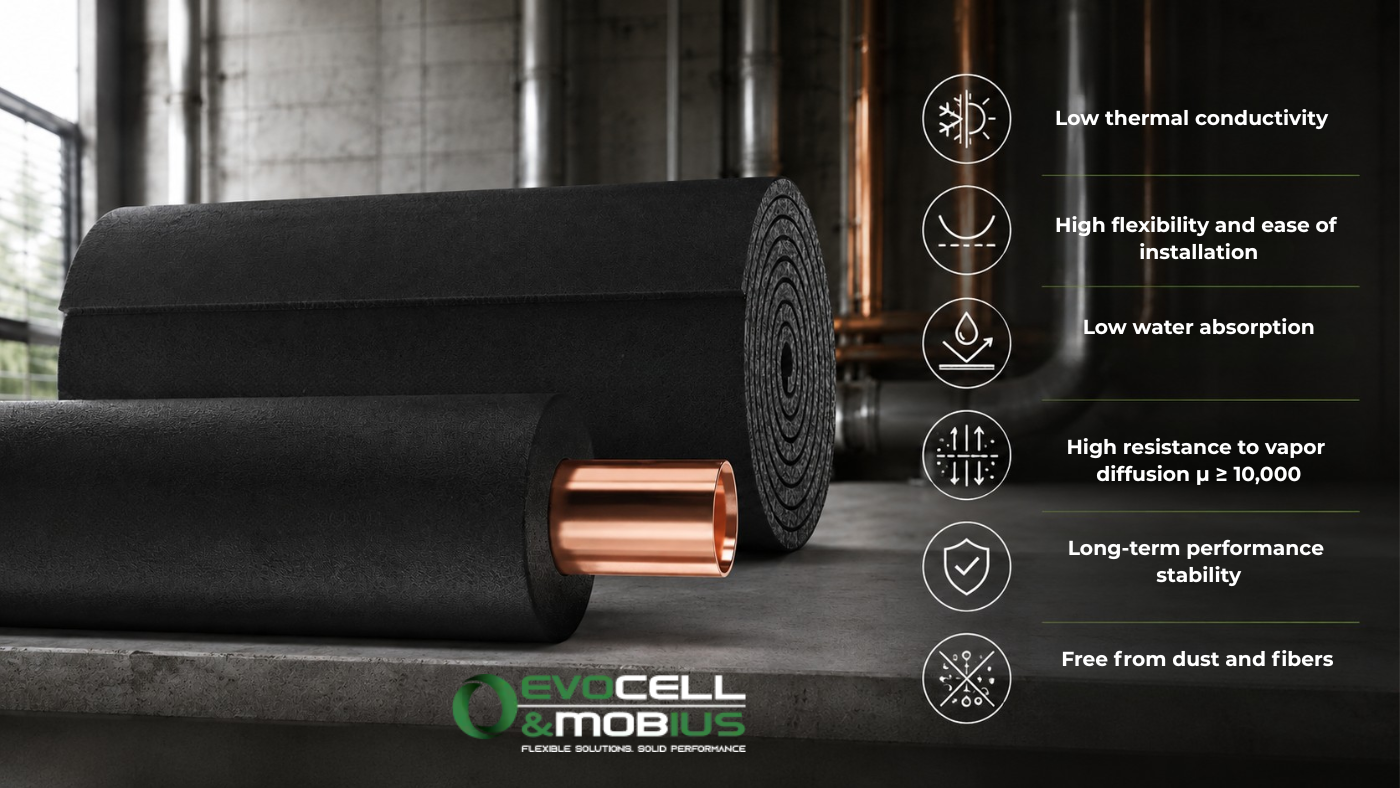
Closed-cell elastomeric foam (FEF) is now one of the most widely used materials in technical insulation thanks to its combination of thermal performance, flexibility, and durability.
Main advantages include:
• low thermal conductivity
• high flexibility and ease of installation
• low water absorption
• high resistance to vapor diffusion (μ ≥ 10,000)
• long-term performance stability
• dust- and fiber-free composition
Unlike other insulation materials, the closed-cell structure integrated into a hydrophobic polymer matrix allows performance to remain constant even in systems operating at temperatures lower than the surrounding environment and under particularly critical operating conditions.
This results in:
✔ simple and fast installation
✔ reduced maintenance requirements
✔ high long-term energy efficiency
✔ longer system lifespan
Thermal Insulation and New European Regulations
In recent years, energy efficiency has become a central issue in building and system design. New European directives promote:
• reduction of energy consumption
• decarbonization of buildings
• improvement of energy performance
• use of more sustainable materials
In this context, thermal insulation plays an increasingly strategic role. An efficient insulation system makes it possible to:
✔ reduce energy consumption
✔ lower CO₂ emissions
✔ improve the energy class of buildings
✔ increase HVAC system efficiency
Investing today in high-performance materials means anticipating future market needs and responding concretely to new environmental and energy regulations.
Discover EVOCELL&MOBIUS Solutions
EVOCELL&MOBIUS develops elastomeric solutions designed to meet the needs of a continuously evolving market, with particular attention to:
• energy efficiency
• quality
• sustainability
• innovation
👉 Discover the complete range of thermal insulation products on our website:
🌐 www.evocellmobius.it
📩 For more information: