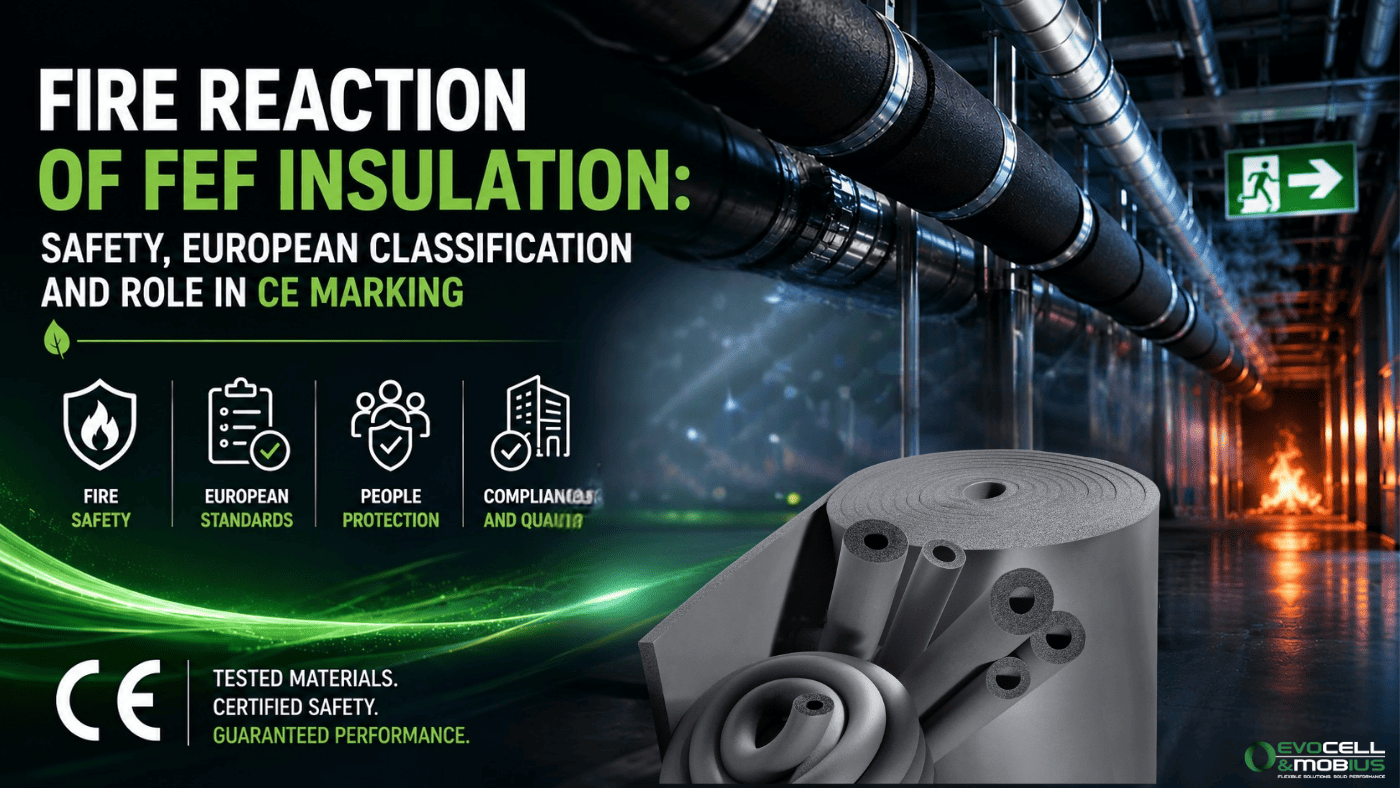
Fire Reaction of FEF Insulation
Fire Reaction of FEF Insulation: Safety, European Classification, and Role in CE Marking
Fire safety starts with the choice of materials
In recent years, fire safety has become one of the most important aspects of building design. The evolution of European regulations, combined with the growing focus on the protection of people and property, has changed the way construction materials are selected. Today, thermal insulation is no longer evaluated solely for its energy performance, but also for its behavior in the event of a fire.
FEF ( Flexible) insulators Elastomeric Foam ) are widely used in HVAC, refrigeration, and industrial applications due to their high thermal insulation performance. However, these materials line pipes and ducts that run throughout the building, passing through technical rooms, shafts, suspended ceilings, fire compartments, and, very often, even escape routes. For this reason, their behavior during a fire is a fundamental element of the overall safety strategy.
Choosing the right material therefore means finding the right balance between energy efficiency, durability, regulatory compliance, and personal safety.
Why fire behavior is so important
When we talk about fires, we tend to immediately think of flames as the main danger. In reality, in the early stages of a fire, the greatest risk is often posed by smoke and combustion gases, which rapidly reduce visibility and make it difficult to navigate emergency exits.
In a building, a few minutes can make the difference between an orderly evacuation and a gravely dangerous situation. If smoke quickly fills corridors and stairwells, people may lose their bearings, delay evacuation, or be unable to reach exits safely. At the same time, rescue team operations become more complex, increasing response times.
Fire spread is also a determining factor. Some materials can significantly contribute to the development of flames or release incandescent droplets or particles that, when falling on other combustible materials, can trigger new outbreaks.
For this reason, modern European regulations don't just assess whether a material is combustible or not, but also analyze its overall behavior when exposed to fire. This is precisely the concept underlying reaction to fire .
The importance of insulation in escape routes
An often underestimated aspect concerns the presence of insulation along escape routes.
In modern buildings, pipes for air conditioning, refrigeration, technical water, and energy distribution systems frequently pass through corridors, stairwells, lobbies, and evacuation routes. Consequently, the insulation installed on the pipes also becomes an integral part of the environment through which people must pass during an emergency.
In these areas, it is essential that the material contributes as little as possible to the fire's spread and produces limited amounts of smoke. Excessive smoke production can quickly impair visibility along escape routes, increasing the time needed to evacuate the building and making the work of rescuers more difficult.
The release of incandescent droplets or particles also represents a risk element.
It's important to emphasize that choosing insulation with high fire performance doesn't replace other fire protection systems, such as compartmentalization, detection systems, or extinguishing systems. However, it is one of the many elements that contribute to the building's overall safety strategy, helping to maintain more favorable conditions during the early stages of a fire.
What is fire reaction really?
One of the most common mistakes is to believe that fire resistance simply indicates whether a material "burns" or not. In reality, the concept is much broader.
Reaction to fire describes the behavior of a material when involved in the initial stages of a fire and measures the contribution that material can make to the development and spread of flames.
Therefore, it is not an assessment of the material's resistance to heat or its ability to maintain its mechanical properties over time. Fire reaction, instead, analyzes how the material participates in a fire when exposed to an ignition source.
Laboratory tests take into consideration three main aspects:
- the contribution to the development of the fire;
- the production of smoke during combustion;
- the release of incandescent droplets or particles.
These three parameters allow different materials to be compared through a harmonized classification system valid throughout the European Union.
How reaction to fire is determined
The European classification of reaction to fire is defined by the EN 13501-1 standard , which assigns the different classes on the basis of standardised experimental tests.
Since fire behavior also depends on the product's geometry, test methods are not identical for all types of insulation. Insulation tubes and sheets exhibit completely different fire exposure patterns and must therefore be assessed using specific procedures.
Tests for insulating panels
For flat products, such as expanded elastomer sheets, the main test is the Single Burning Item (SBI) , defined by the EN 13823 standard .
During the test, the sample is installed in an angled configuration that reproduces the behavior of a material applied to a wall. A burner placed at the base generates a fire, and dedicated instruments measure various parameters, including the heat generated, the speed of flame spread, and the amount of smoke produced.
This test is accompanied by the ignitability test required by the EN ISO 11925-2 standard , in which the material is directly exposed to a small flame to verify the ease of ignition and the spread of combustion in the early stages of the fire.
The set of results obtained from these tests allows us to assign the correct fire reaction class according to EN 13501-1.
Tests for insulating pipes
Insulation materials intended for pipes require a different methodology.
The particular cylindrical geometry and the presence of the pipe in fact influence the behaviour of the material during a fire and make the use of the same configurations envisaged for the slabs inappropriate.
For this reason, European legislation requires dedicated tests for linear products (Linear Pipe Thermal Insulation Products) , developed to simulate real installation conditions as faithfully as possible.
Here too, the contribution to the development of the fire, smoke production, and the release of incandescent droplets are assessed. The difference lies in the test configuration, which is specifically designed for products installed around pipes.
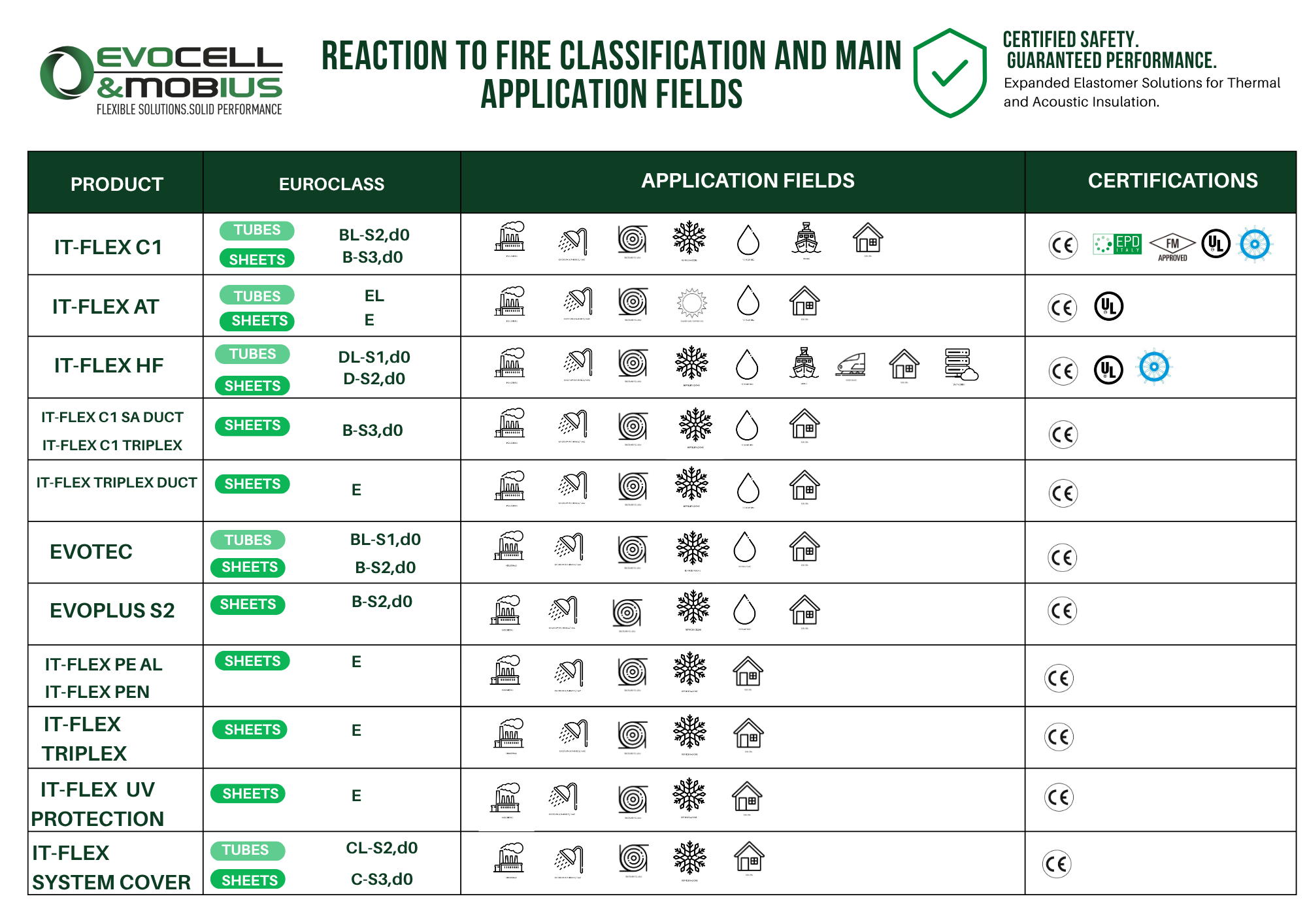
This specific methodology gives rise to the presence of the letter L in the classification, which identifies linear products. Therefore, an insulating product in the form of a tube can have a class B L -s 2,d0 where the presence of the L simply indicates "Linear", i.e. a product with a linear development .
BL-s 2,d 0 classification for an insulating tube and Bs 2,d 0 for a sheet: the difference does not indicate better or worse performance, but simply that the two products have been evaluated according to different test procedures, developed to represent their real use .
How to read the European fire reaction classification
To enable designers, installers, and users to compare different materials according to common criteria, the European Union has adopted the classification system defined by the EN 13501-1 standard . This standard currently represents the reference for assessing the reaction to fire of construction products and allows the behavior of a material in the early stages of a fire to be expressed through a standardized acronym.
The classification is composed of three main elements, each of which describes a specific aspect of the material's behavior.
The main class
The first parameter is represented by a letter that identifies the contribution of the material to the development of the fire.
The classes planned are:
- A1 : non-combustible material, which does not contribute to the fire.
- A2 : extremely limited contribution.
- B : very limited contribution.
- C : limited contribution.
- D : significant contribution.
- E : minimum behavior verified by ignition test .
- F : undetermined or unclassified performance.
For elastomeric insulation intended for HVAC systems, it is common to find products classified as class B , which represents one of the highest levels achievable for this type of material.
It's important to note that the primary class alone doesn't describe the product's overall behavior. Two materials both classified as Class B can differ significantly in their smoke production or the release of incandescent droplets.
Smoke production
The second parameter is identified by the letter s (smoke).
Smoke is one of the main risk factors during a fire. Besides potentially containing harmful combustion products, it rapidly reduces visibility and makes it difficult for people to find their way along escape routes.
The classification distinguishes three levels:
- s1 : very limited smoke production;
- s2 : limited smoke production;
- s3 : no specific performance limits set by the standard.
From a safety perspective, a lower value generally represents better performance, as it helps maintain more favorable evacuation conditions.
Glowing drops and particles
The last parameter of the classification is identified by the letter d ( droplets ).
During combustion, some materials can release incandescent droplets or fragments which, falling on other combustible elements, can cause new fires to start.
The classification distinguishes:
- d0 : no glowing drops or particles;
- d1 : limited release;
- d2 : unrestricted release or performance not compliant with higher requirements.
This parameter takes on particular importance in environments characterised by the presence of other combustible materials or along routes where the spread of fire must be limited as much as possible.
A practical example: how to read a classification
One of the most frequent classifications in elastomeric pipe insulation is B L -s 2,d 0 .
This acronym can be interpreted in the following way:
- B indicates that the material makes a very limited contribution to the development of the fire.
- L identifies a product intended for the insulation of linear elements, such as pipes and fittings, classified using the specific tests required for this category.
- s2 indicates limited smoke production.
- d0 certifies the absence of incandescent drops or particles during the tests.
In the case of slabs, the classification will be, for example, Bs 2,d 0 or Bs 3,d 0 (depending on the type of product), without the letter L , since the test method is specific to the slabs .
For this reason, it is essential to always read the classification in its entirety and not limit yourself to just the initial letter.
Reaction to fire as an essential performance of the CE marking
For thermal insulation products made of expanded elastomer, reaction to fire is not only a technical characteristic useful for design purposes, but constitutes an essential performance pursuant to the Construction Products Regulation (CPR - EU Regulation No. 305/2011) .
The CPR introduced a harmonized system at the European level with the aim of making the performance of construction products marketed in different Member States comparable. The CE marking, in fact, does not represent a quality label or a certification of product superiority: it is a declaration that the manufacturer has determined the performance of its product according to the procedures established by the harmonized European standards.
In the case of FEF insulation, the harmonized reference standard is EN 14304 , dedicated to insulating products for building systems and industrial installations.
The essential performances required by the standard include, in addition to thermal and dimensional characteristics, reaction to fire . This means that the manufacturer cannot freely declare a class, but must determine it through tests performed according to the applicable European standards.
The value obtained is reported in the Declaration of Performance ( DoP ) , a mandatory document that accompanies the CE marked product and that allows designers, construction managers, installers and clients to transparently know the performance declared by the manufacturer.
The DoP is therefore the main tool through which the manufacturer communicates the essential characteristics of its product and represents the official reference for verifying compliance with design and regulatory requirements.
The role of the AVCP system
To ensure the reliability of the declared performances, the CPR also provides specific systems for the Evaluation and Verification of Constancy of Performance (AVCP) .
The applicable system depends on the type of product and the characteristic being assessed. In the case of reaction to fire, the initial tests and required checks involve independent notified bodies, which verify the correct determination of performance as established by the harmonized standards.
This mechanism, with the related Certificate of Constancy of Performance issued by the notified body, guarantees that the reaction to fire class reported in the CE marking is not a simple commercial declaration, but the result of an evaluation process defined by European legislation.
For designers and installers, this represents an important element of reliability, as it allows them to compare products from different manufacturers based on common, verifiable and recognized criteria throughout the European Union.
Why knowing fire reaction helps design safer buildings
The fire reaction classification today represents one of the most important tools for the informed choice of materials intended for systems.
Understanding the meaning of European classes allows us to evaluate not only the energy efficiency of an insulation material, but also its behavior during the early stages of a fire, when every minute can be crucial for the evacuation of occupants and the intervention of rescuers.
This aspect is particularly important in public buildings, hospitals, schools, hotels, shopping centres and, more generally, in all structures characterised by a high presence of people or complex escape routes.
In these contexts, choosing materials that limit their contribution to the fire, reduce smoke production, and prevent the release of incandescent droplets is a fundamental element of the fire prevention strategy, along with compartmentalization, detection systems, evacuation systems, and active and passive protection measures.
FEF insulation is now an essential component for ensuring the energy efficiency of systems, but its role goes far beyond simply limiting heat loss.
The behavior of the material in the early stages of a fire can influence the spread of the flames, the amount of smoke produced and, consequently, the safety conditions inside the building.
The fire reaction classification, obtained through standardized tests and declared as part of the CE marking, therefore represents a fundamental tool for choosing products that comply with European requirements and are suited to design needs.
Understanding the meaning of the classification, understanding how it is determined, and knowing how to correctly interpret the information provided in the Declaration of Performance allows designers, installers, and clients to make more informed choices, contributing to the creation of efficient systems that comply with regulations and are geared toward protecting people's safety.
📩 For more information: