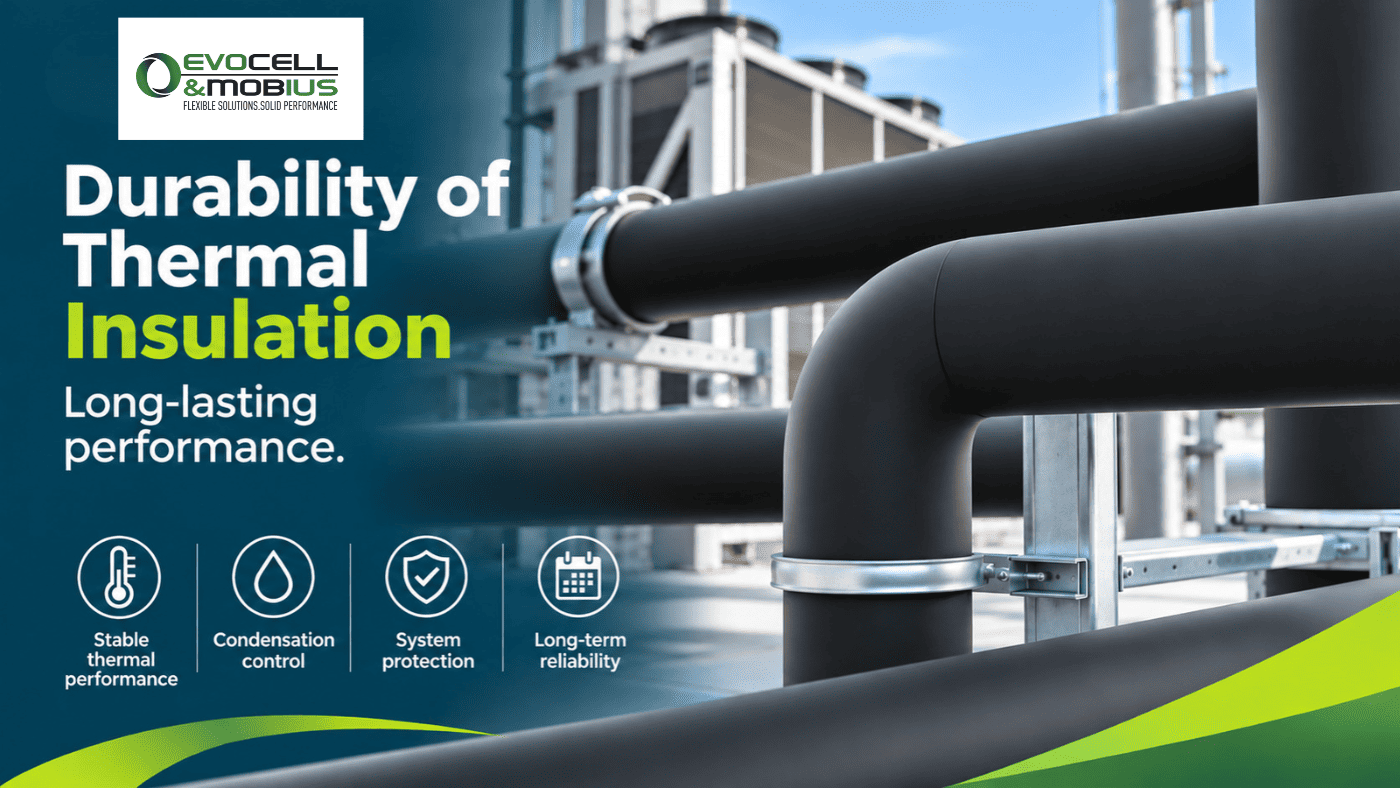
Durability of Thermal Insulation
How to Maintain Efficiency and Performance Over Time
Effective thermal insulation must not only provide good initial performance but also maintain it throughout the operational life of the system. The choice of materials, environmental conditions and installation quality are determining factors in ensuring energy efficiency, reliability and infrastructure protection.
In HVAC systems, refrigeration and industrial applications, thermal insulation performs an essential function: limiting unwanted heat transfer, contributing to condensation control and protecting components from environmental conditions.
But which factors can compromise insulation performance over time? And why is closed-cell elastomeric foam a particularly interesting solution for numerous applications?
What Does Durability of Thermal Insulation Mean?
The durability of an insulation system is its ability to maintain the performance required by the design over time, under the intended operating conditions.
It therefore concerns not only the physical resistance of the material but also includes several aspects:
- Stability of thermal performance, to continue limiting heat transfer.
- Resistance to water vapour diffusion, particularly important in systems operating at low temperatures.
- Integrity of the insulation system, including joints, fittings and connection points.
- Compatibility with operating conditions, such as temperature, humidity and any mechanical stresses.
- Protection against external agents, when the installation is exposed to UV radiation, weather conditions or potential damage.
A material with good initial characteristics may lose its effectiveness if used under inappropriate conditions or installed without ensuring insulation continuity.
For this reason, durability must be considered from the design stage.
Moisture and Condensation: Two Factors Not to Be Underestimated
In refrigeration, air conditioning and chilled-water distribution systems, the presence of moisture represents one of the main challenges in maintaining insulation performance.
When the surface temperature of a pipe falls below the dew point of the surrounding air, condensation may form.
Correctly sized insulation helps maintain the external surface temperature under the conditions specified by the design, reducing the risk of condensation.
It is equally important to limit the penetration of water vapour into the insulation system.
The presence of moisture can compromise the thermal effectiveness of certain materials and promote corrosion on the underlying metal surfaces.
The choice of insulation must therefore take into account not only thermal conductivity but also resistance to water vapour diffusion and the correct execution of joints.
Closed-Cell Elastomeric Foam: Characteristics and Advantages
Flexible elastomeric foam (FEF) is a material used for the thermal insulation of HVAC systems, refrigeration and numerous industrial applications.
Its closed-cell structure combines two particularly important characteristics:
Low Thermal Conductivity (λ)
It limits heat transfer between the system and the surrounding environment, contributing to energy efficiency.
High Resistance to Water Vapour Diffusion (μ)
It helps prevent vapour from passing through the material, an aspect particularly relevant in low-temperature applications.
The flexibility of elastomeric foam also facilitates adaptation to pipes, bends, fittings and components with different geometries.
These properties make FEF an interesting solution when thermal performance, condensation control and insulation continuity need to be combined.
However, it is important to remember that characteristics vary depending on the formulation and the product: selection must always be based on declared performance and actual conditions of use.
Correct Installation Influences the Durability of Performance
The durability of thermal insulation does not depend exclusively on the material.
Even high-performance insulation may be less effective if installation involves discontinuities, improperly sealed joints or parts of the system without adequate protection.
Particular attention must be paid to:
- Longitudinal and transverse joints, which must ensure the continuity of the insulation system. Particularly in systems operating with cold fluids, joints, including those connecting to system components such as valves or pumps, must be bonded to the FEF using a specific adhesive.
- Bends, fittings and valves, where the geometry may make installation more complex. Any discontinuity in the thermal insulation and/or compression or stretching of the insulation must be avoided. For example, preformed elastomeric bends are preferable to simply sliding the insulation tube over the bend.
- Pipe supports, which may represent critical points for thermal continuity and condensation control. Insulating supports must be bonded to the thermal insulation.
- Adhesives and accessories, to be selected according to the material and application conditions.
- Surface protection, necessary when the insulation is exposed to stresses or environmental agents incompatible with the material when left uncovered. The insulation must be protected immediately after installation.
Careful design and correct installation help preserve the effectiveness of the insulation system during system operation.
Operating Conditions and Maintenance: Why Are They Important?
Each application has different operating conditions.
An industrial refrigeration system, an HVAC network inside a building and a pipe installed outdoors may subject the insulation to very different stresses.
For this reason, operating temperature, ambient humidity, exposure to weather conditions and any mechanical stresses must be carefully assessed.
In outdoor applications, for example, specific protection against UV radiation and weather conditions may be necessary.
System maintenance also plays an important role: work carried out on pipes, valves and components may locally compromise insulation continuity if the system is not properly restored.
Periodic checks of the integrity of surfaces, joints and the most exposed points can help identify potential issues before they affect overall performance.
Declared Performance and Material Selection: The Role of EN 14304
Selecting reliable thermal insulation requires verifiable performance data.
The UNI EN 14304 standard defines the requirements for flexible elastomeric foam (FEF) products manufactured for the thermal insulation of building equipment and industrial installations.
The standard covers product characteristics and procedures relating to testing, conformity assessment and declaration of performance.
Compliance with the standard therefore represents an important reference for the technical evaluation of materials.
However, it does not, in itself, guarantee identical durability for all applications: system performance also depends on sizing, operating conditions and correct installation.
It is therefore essential for designers and installers to consult technical data sheets and verify that the declared characteristics are suitable for the specific requirements of the system.
Solutions for Reliable Thermal Insulation
The EVOCELL&MOBIUS product range includes closed-cell flexible elastomeric foam solutions designed for the thermal insulation of HVAC systems, refrigeration and industrial applications.
Tubes, sheets, rolls and accessories make it possible to create different insulation configurations according to the characteristics of the system.
The choice of the most appropriate solution must take into account thermal performance, resistance to water vapour diffusion, operating temperatures and any specific application requirements.
The objective is not only to achieve effective insulation at the time of installation but also to create the conditions for the required performance to be maintained over time.
Durability Begins with Design
Effective thermal insulation is the result of an overall assessment involving the material, sizing, installation and operating conditions.
Considering durability from the earliest stages of a project means contributing to performance continuity, energy efficiency and system reliability.
Are you designing an HVAC system, a refrigeration system or an industrial application?
The EVOCELL&MOBIUS team is available to support you in choosing the solutions best suited to the characteristics of your project.
Contact us for more information.